Blog
The Difference Between Tartan and Plaid — Explained Once and For All

Where did the confusion come from?
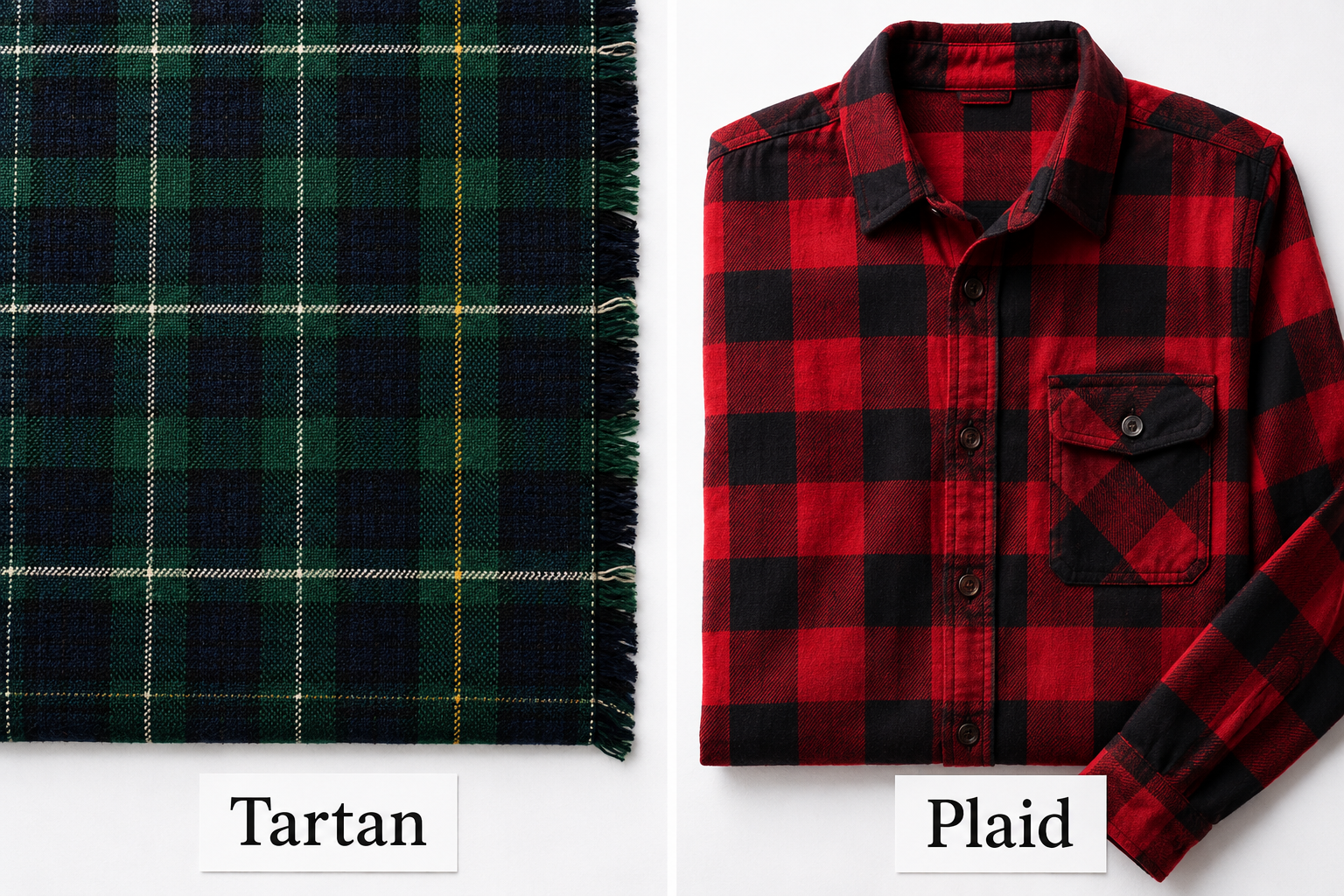
The mix-up is largely an American one — and it dates back centuries. When Scottish immigrants arrived in North America, they brought their tartans with them. Over generations, the Gaelic word “plaid” (meaning blanket or wrapped garment) drifted into everyday American English as a catch-all term for any criss-cross woven pattern.
Today, American retailers label flannel shirts, scarves, and pyjamas as “plaid” — even when the pattern has no Scottish origin, no registered structure, and no cultural meaning. It is a pattern. Tartan is a heritage.
A brief history of tartan
3rd century AD
The earliest evidence of tartan-like woven cloth is found in Scotland — small fragments of checked wool fabric discovered in burial sites.
16th–17th century
Tartan becomes widespread across the Scottish Highlands, worn as a full-body wrap called the “belted plaid” — the ancestor of the modern kilt.
1746
After the Battle of Culloden, the British government banned the wearing of tartan in the Dress Act — an attempt to suppress Highland culture. The ban lasted 36 years.
1822
King George IV visits Scotland, sparking a massive revival of tartan and Highland dress. Clan tartans are formalised and romanticised during this period.
2009
The Scottish Register of Tartans is established — an official government database that records and protects tartan designs. Today it holds over 7,000 entries.
What makes a tartan a tartan?
A genuine tartan isn’t just a pattern — it has a precise, repeatable structure called a sett. The sett is a formula that records the exact sequence and width of coloured threads, woven both horizontally and vertically to create the distinctive criss-cross effect.
A plaid shirt from a high street shop has none of this. Its pattern may look similar to the untrained eye, but it has no sett, no registration, and no cultural lineage. That’s the fundamental difference.
Common myths — busted
“Tartan and plaid are the same thing.”Only in American English. In Scotland, a plaid is a garment — not a pattern. Calling a tartan a “plaid” is like calling a suit jacket a “fabric.”
“Every criss-cross pattern is a tartan.”No — tartan has a registered sett structure and cultural identity. A random checked pattern on a blanket is just a checked pattern.
“Clan tartans are ancient — each clan has always had its own.”Most clan-specific tartans were only formalised in the early 19th century, particularly around the 1820s Highland revival. Some are even more recent.
“Only Scots can wear tartan.”Not at all. Universal tartans like Black Watch and Royal Stewart are open to everyone. Many countries, organisations, and even businesses have their own registered tartans.
So what is a “plaid” in Scotland?
In traditional Scottish dress, a plaid (pronounced “plad”) is a large rectangular piece of tartan cloth — typically around 5 metres long — draped over the shoulder and fastened with a brooch. It is a garment, not a pattern.
The most famous form is the belted plaid or “feileadh mòr” — the great kilt — which was both wrapped around the waist as a skirt and draped over the upper body. The modern kilt evolved from this when the upper half was separated into a standalone garment.
Women wear a version called a fly plaid — a smaller square of tartan pinned at the shoulder over Highland dress. It remains a central part of formal Celtic attire today.
💡 Celtic Attire Tip
When shopping for authentic Celtic clothing, always look for the word “tartan” — and ideally a named pattern (like “Hunting Stewart” or “Black Watch“). If a product only says “plaid print,” it is likely a fashion item, not an authentic woven tartan.
Quick reference: tartan vs plaid
Tartan
✦ Specific registered pattern
✦ Built on a mathematical sett
✦ Tied to clan, family or region
✦ Woven in wool traditionally
✦ Cultural and heritage symbol
✦ Scottish in origin
Plaid (American usage)
✦ Any criss-cross pattern
✦ No set structure or sett
✦ No cultural identity
✦ Any fabric or material
✦ Fashion / decorative term
✦ Global usage